

Lifetime Value Calculator: Customer Lifetime Value Formula + Examples
If you don't know the lifetime value of a customer, it's easy to underinvest in marketing (and stall growth) or overspend (and kill profit). Our free lifetime value calculator helps you estimate how much one new patient/customer is worth over time — and what a steady stream of new patients means for revenue.
TL;DR
- LTV tells you what one patient/customer is worth across the relationship.
- Use LTV to set a rational marketing budget (CAC target) and avoid guessing.
- The most practical lever is usually retention — small improvements can beat huge ad spend.
What is the lifetime value of a customer?
Lifetime value (often called LTV or CLV) is the total revenue you expect to generate from one customer over the entire time they stay with you.
For a dental practice, LTV is driven by the average revenue per visit, how many visits happen per year, how long patients stay, and additional accepted treatments.
Customer lifetime value formula (simple + useful)
There are many versions of the customer lifetime value formula. The best one is the one you can actually measure and use.
Lifetime value formula
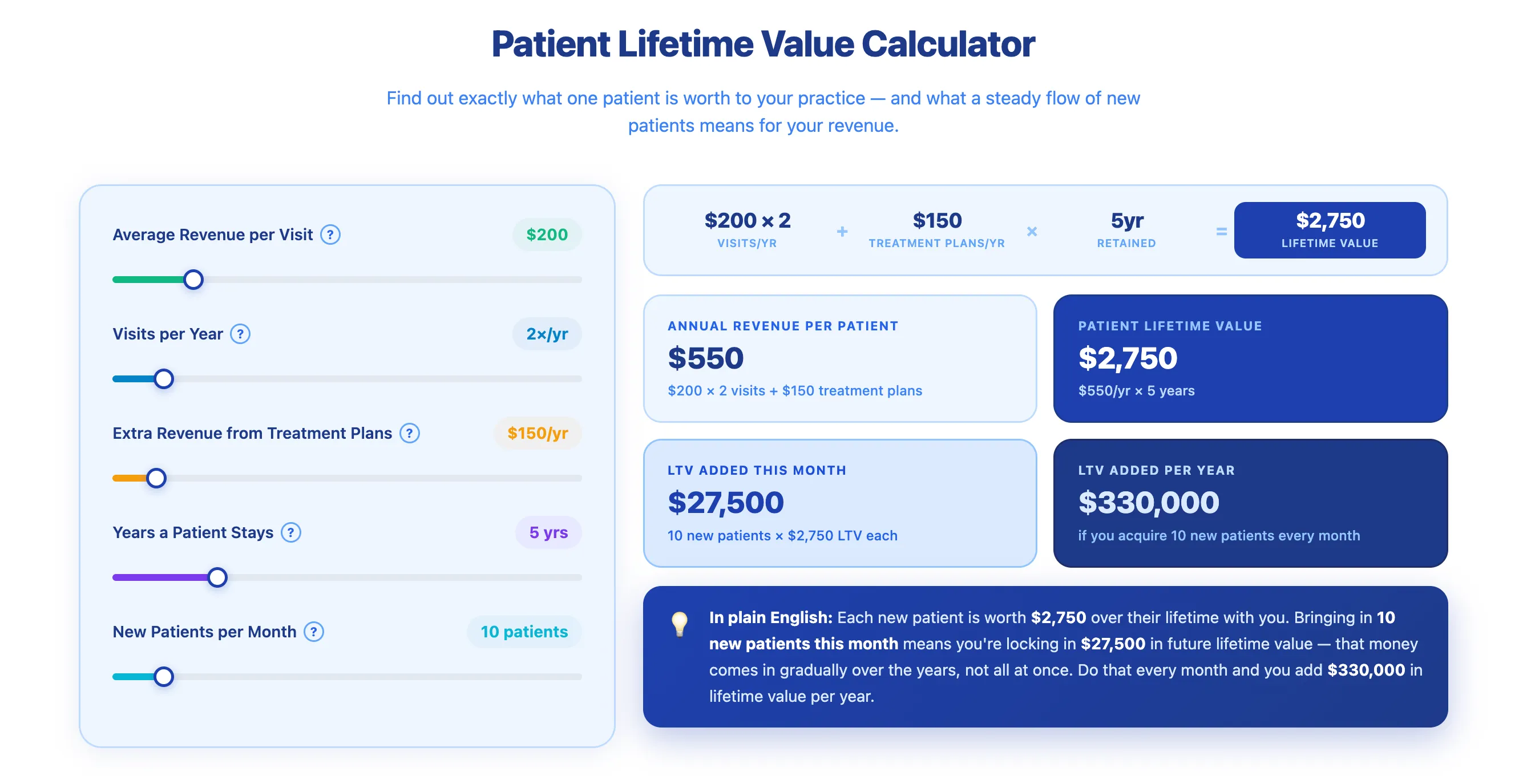
Lifetime Value = (Avg Revenue per Visit × Visits per Year + Extra Treatment Revenue per Year) × Years Retained
This matches how our calculator works: it focuses on the core economics that matter for real-world decisions.
Lifetime value calculation (worked example)
Here's a quick lifetime value calculation you can compare against your own practice numbers:
Example
- Avg revenue per visit: $200
- Visits per year: 2
- Extra treatment revenue (per year): $150
- Years retained: 5
LTV = ($200 × 2 + $150) × 5 = $2,750
Why a lifetime value calculator matters (beyond curiosity)
- Set a clear CAC ceiling: If LTV is $2,750, paying $25 per lead or $250 per new patient might be reasonable — depending on margins.
- Decide between channels: SEO, Google Ads, referrals, local partnerships — compare the cost per acquired patient to your LTV.
- Make retention investments rational: recall systems, reactivation, better scheduling, membership plans.
- Forecast growth: multiply LTV by new patients per month to estimate future lifetime revenue added.
The 5 variables that move LTV the most
If you want LTV to go up, you typically don't need complex finance models — you need to improve one of these:
- Average revenue per visit: coding, case acceptance, service mix.
- Visits per year: recall compliance, hygiene capacity, scheduling.
- Extra treatment revenue: treatment plan acceptance, patient education.
- Years retained: experience, follow-up, convenience, trust.
- New patients per month: marketing, reputation, listings, and conversion.
Common mistakes when calculating lifetime value
- Using revenue instead of profit: LTV is often discussed as revenue, but CAC should be set using margin-aware numbers.
- Assuming retention without tracking it: pull real retention from your PMS if possible.
- Ignoring treatment variability: use a conservative average and revisit it quarterly.
- Comparing channels without the same definition: make sure “new patient” means the same in every report.
Use the free lifetime value calculator
Open the life time value calculator and adjust the sliders to match your practice. In under a minute, you'll see your patient lifetime value and the lifetime revenue added by your monthly new patient flow.
No sign-up. Instant results.
Built for growth-focused practices by First Stop Dental.