

Dental Break Even Calculator: How Many Patients Do You Actually Need?
The single most important number in your practice isn't your production target or your collection rate. It's your break even point — the exact number of patient visits per month where revenue covers every dollar going out the door. Below that number, you're losing money. Above it, every patient is profit. Use our free Dental Break Even Calculator to find your number in under three minutes, then read on to understand what it's telling you.
What Is a Break Even Analysis for a Dental Practice?
A break even analysis is the calculation that tells you exactly when total revenue equals total costs. No profit yet, but no loss either. For most small businesses, this is a useful benchmark. For dental practices, it's an essential survival number.
Why dentistry specifically? Because dental practices carry some of the highest fixed overhead of any small business: equipment loans, specialist staff, sterilisation compliance costs, practice management software, and commercial leases that don't flex when your schedule does. A quiet week doesn't lower your rent. A missed hygiene appointment doesn't reduce your payroll. Your costs run whether the chair is full or not — which makes knowing your breakeven patient count critical, not optional.
Once you know your break even number, three things immediately get easier:
- You know exactly how many new patients your marketing needs to deliver each month
- You can model what happens financially before adding a hygienist or opening another operatory
- A slow month stops being a source of anxiety and becomes a number you can plan for
The Break Even Formula (Plain English Version)
The break even formula
Break Even Patients = Fixed Costs ÷ (Revenue per Visit − Direct Cost per Visit)
The bottom half — revenue per visit minus direct cost per visit — is your Contribution Margin. It's what each patient visit actually contributes toward covering your fixed bills.
Here's a real-world example of the breakeven calculation in action:
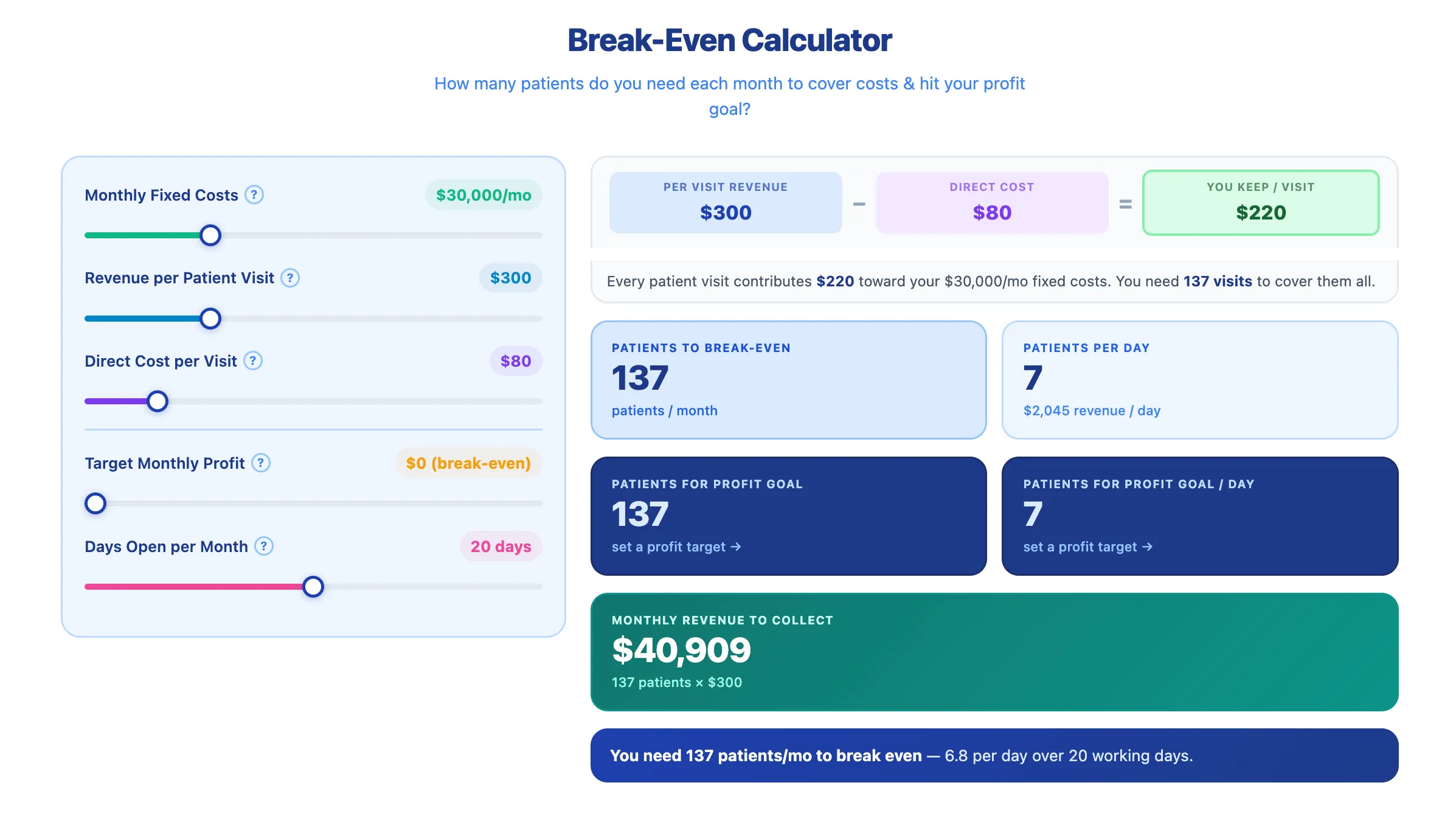
- Monthly fixed costs (rent, staff salaries, insurance, software): $30,000
- Average revenue per patient visit: $300
- Direct cost per visit (supplies, lab fees, disposables): $80
Contribution margin: $300 − $80 = $220 per visit. Break even point: $30,000 ÷ $220 = 137 patients per month, or about 7 patients per working day on a standard 20-day schedule.
Want to take home an additional $8,000 per month? The break even formula extends to: ($30,000 + $8,000) ÷ $220 = 173 patients. Now you have a real number to hand to whoever handles your marketing — not a vague sense that you need "more patients."
How to Use the Free Dental Break Even Calculator
Our Dental Break Even Calculator was built specifically for dental practices — not generic business owners. It separates fixed overhead from per-visit variable costs, which matters in dentistry because a crown appointment and a check-up share the same fixed cost base but carry wildly different supply costs.
Move five sliders and you instantly get:
- Patients to Break Even — your minimum monthly visit count
- Patients Per Day — what that target looks like in your daily schedule
- Patients for Your Profit Goal — once you set a target take-home
- Monthly Revenue to Collect — the gross number your front desk should be tracking
- Contribution Margin % — a health check on your pricing and cost structure
No sign-up. No spreadsheet. Your number in seconds.
Getting the Inputs Right
The break even analysis is only as accurate as the numbers you feed it. These are the three inputs that most practice owners get wrong:
Fixed costs — go higher than your first instinct
Most dentists underestimate here because they forget the quiet line items: annual compliance training, CE credits, equipment servicing contracts, website hosting, and the subscriptions that bill monthly without ever appearing on a single large invoice. A realistic fixed cost figure for a single-chair practice typically runs between $15,000 and $35,000 per month. Multi-operatory practices can easily exceed $80,000.
Average revenue per visit — use your actual patient mix
Don't use your crown fee. Use the blended average across everything you actually bill — routine cleans ($180–$250), fillings ($200–$350), emergencies ($150–$300), and the occasional implant case that pulls the average up. Pull this directly from your practice management software. For most general practices, the realistic average sits between $220 and $380 per appointment.
Direct cost per visit — supplies only, not staff
This is where the most confusion lands in any dental break even analysis. Direct costs are only what goes up when you see one more patient: gloves, masks, disposable barriers, impression materials, lab fees for that specific visit. Staff wages go in fixed costs — you pay them whether the chair is full or empty. Mixing the two inflates your contribution margin and gives you an optimistic break even number that doesn't reflect reality.
What a Healthy Contribution Margin Looks Like
Once you run your breakeven calculation, the result will show your contribution margin as a percentage. Here's a quick benchmark for dental practices:
- 65% or above — Strong. Your pricing and cost structure are working well together.
- 50–65% — Solid. Room to improve, but not a warning sign.
- Below 50% — Your per-visit costs are eating too much of each fee, or your fees are below market for your area.
If you're below 50%, the fix is almost always one of two things: renegotiating lab fees and supply contracts, or revisiting your fee schedule. Neither conversation is comfortable — but both become easier when you've got the data sitting in front of you rather than a gut feeling.
Three Ways to Lower Your Break Even Without Seeing More Patients
Most dentists look at their break even number and think "I need more patients." That's one path — but the break even formula has three levers, not one.
- Lower fixed costs. Audit your subscriptions, renegotiate your lease at renewal, or consolidate software tools. Cutting $3,000 per month from fixed overhead is the equivalent of seeing roughly 14 extra patients — without changing your schedule at all.
- Raise average revenue per visit. Promoting higher-value services — implants, clear aligners, sleep dentistry — shifts your average upward and improves your contribution margin in every future breakeven calculation. A $50 rise in average revenue across 150 monthly patients is $7,500 per month.
- Reduce direct costs per visit. Consolidating supply orders, joining a buying group, or switching labs can bring your per-visit cost down. A $10 reduction per visit saves $1,370 per month at 137 patients — real money from a single supplier conversation.
The calculator lets you test all three scenarios in real time. Try dropping your direct cost by $10 and watch how the break even patient count shifts. Small numbers in a formula translate to very real differences in how your practice actually feels to run.
Practical Decisions the Break Even Analysis Changes
Should you hire another hygienist?
Adding a hygienist increases your fixed costs by roughly $4,000–$6,000 per month in salary and on-costs. Plug that into the break even calculator and you'll see exactly how many additional hygiene appointments per month you need to justify it. If the answer is 22 extra visits and you're already turning patients away three days a week, it's an easy yes. If you're struggling to fill your current book, it's a clear no — for now.
How much should you spend on marketing?
If your contribution margin is $220 per visit and your average patient stays for five years and sees you twice annually, each new patient delivers $2,200 in lifetime contribution. That's your rational ceiling for new patient acquisition cost — and it gives you a hard number for evaluating Google Ads spend, SEO retainers, or a new website before you commit.
What does a slow month actually cost you?
If your break even is 137 patients and December brings in 110, you know exactly what the shortfall looks like: 27 patients × $220 contribution margin = $5,940 out of pocket. That's not a surprise anymore. It's a number you can build a cash reserve around.
From Break Even to Growth: Connecting Your Numbers to New Patients
Once you know your break even and profit-target patient counts, the natural next question is: where do new patients actually come from? For most dental practices today, it starts online — a Google search, a click on your Business Profile, or a referral that gets confirmed by checking your website before booking.
This is where the financial work connects directly to your digital presence. If you need 20 new patients per month to hit your profit goal and your website is generating three enquiries, you now have a specific, quantified marketing gap — not a vague sense that you should "probably do more online." You can take that number to a dental SEO strategy and evaluate it properly against what it will actually cost you per new patient.
First Stop Dental is built around exactly this — helping practices understand their numbers, then build a digital presence that converts online visitors into booked appointments through AI-powered reception, mobile-first design, and built-in SEO tools.
Run Your Breakeven Calculation Now
Your break even number isn't a scary figure. It's a clarifying one. Once you know it, every decision gets simpler — hiring, spending on marketing, pricing a new service, or just knowing whether a slow month is a genuine problem or normal variation.
Take three minutes, plug in your real numbers, and find out exactly where your practice stands.
Find your break even point — free, instant, no sign-up
The Dental Break Even Calculator gives you your monthly patient target, daily schedule target, and profit goal in seconds. Built specifically for dental practices by First Stop Dental.